GUIDE

Christmas photography and photographing Santa

Christmas tree lights, the glow of candles, snowy evenings and of course Santa Claus. This guide helps you capture the Christmas atmosphere with both a camera and a phone, so your photos keep the warm light instead of grey flash.

EXAMPLE

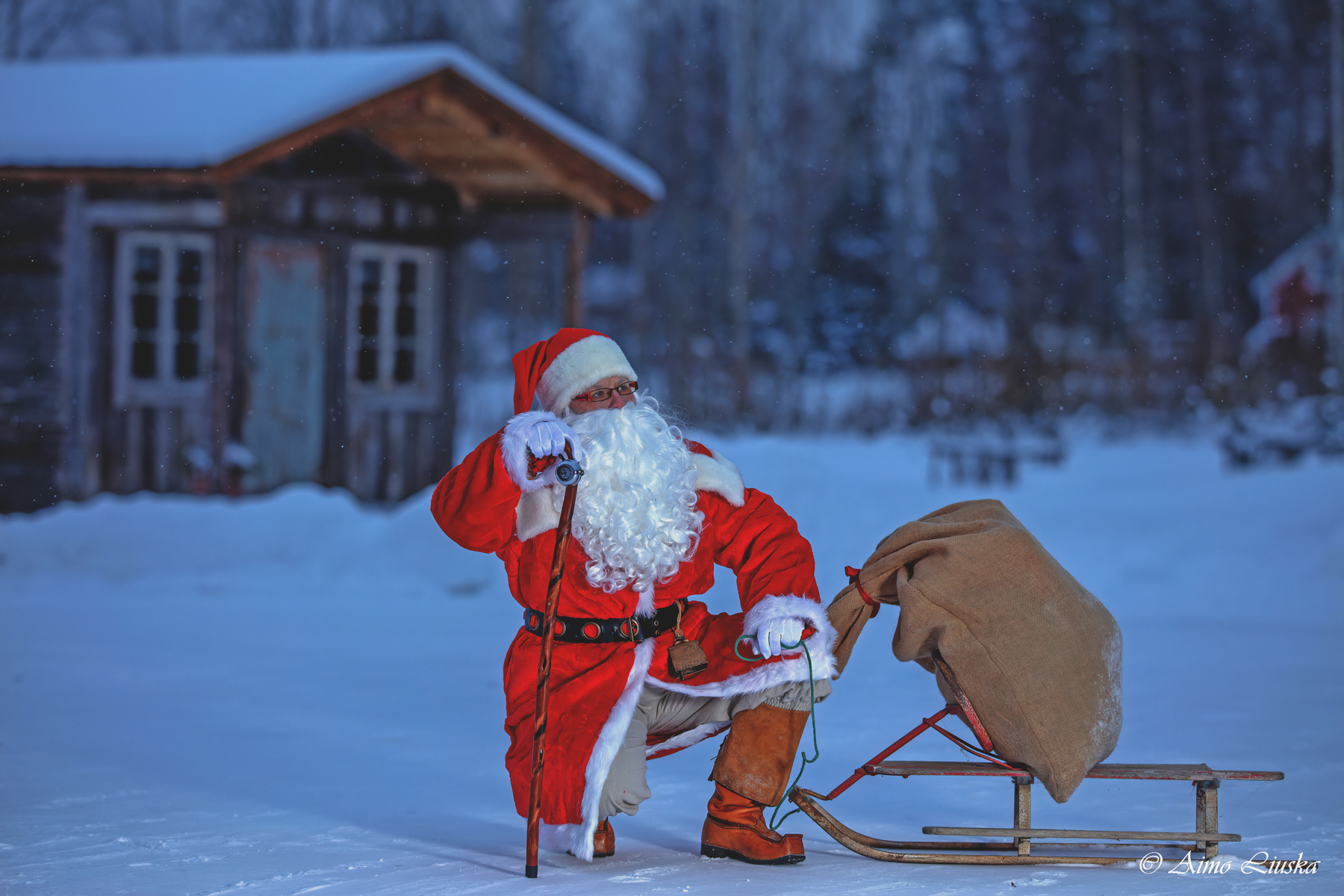
Santa in the blue hour

Santa Claus kneeling beside a sledge and a sack of presents in a snowy yard, an old log storehouse in the background Why the photo works: The photo was taken in the blue hour, just after sunset. The blue tone of the background makes Santa's red suit glow, because blue and red are complementary colours. A long focal length and a wide aperture blur the storehouse and the forest so that they tell you about the place but don't draw attention. Gently falling snow and the old sledge bring the story.
SECTION 1

1. Photographing Santa outdoors

Santa is a rewarding subject: a red suit, a white beard and a figure everyone recognises. With these tips the photo becomes a storybook cover and not just a snapshot.

The setting tells the story A log wall, a storehouse, an old sledge, a lantern or a snow-covered spruce forest tell you where Santa is coming from. Plastic Christmas decorations and a car in the background break the mood, so look at the background before you press the shutter.
Shoot in the blue hour About 20–40 minutes after sunset the snow turns blue, and the red suit stands out beautifully against it. In December this moment comes already in the afternoon in South Ostrobothnia (western Finland), around 15–16. Check the times in the calculator
Winter sun from the side In December the sun is low all day. Side light brings out the curls of the beard and the texture of the suit. Avoid shooting with the sun straight in Santa's face, because then he has to squint.
A long focal length Shoot from further away at a focal length of 85–200 mm and an aperture of f/2.8–f/4. The background blurs softly, and Santa stands out clearly from it. On a phone, portrait mode works. Depth of field
Snow comes out grey The camera's light meter thinks the snow is too bright and darkens the photo. Add exposure compensation of +0.7…+1.3 EV, and the snow stays white.
Focus on the eyes The beard and glasses confuse autofocus. Use eye detection or single-point focus on the eyes. Focus modes
EXAMPLE

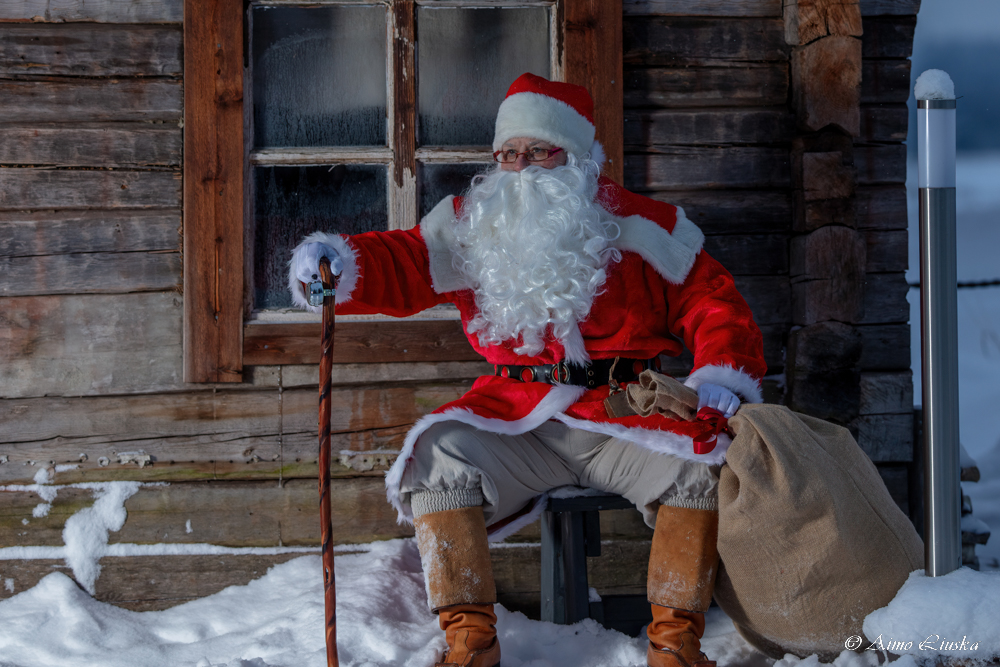
Santa in the winter sun

Santa Claus sitting under the window of an old log cabin with a sack of presents beside him and a walking stick in his hand Why the photo works: The low winter sun lights Santa from the side, and the frosty window and weathered log wall look like something from a storybook. Santa is framed slightly off-centre, and the sack and the stick fill the frame. Every object tells you something. The snow is exposed white, not grey.
SECTION 2

2. Santa's visit indoors on Christmas Eve

In Finland Santa visits homes on Christmas Eve. The visit lasts only a moment, and it can't be done again. Prepare in advance:

1

Settings ready before the knock

Choose A mode, an aperture of f/2.8 or the widest possible, Auto-ISO up to 6400 and a minimum shutter speed of 1/200 s. Children move fast, so shoot in burst mode.

2

Flash off or at the ceiling

Direct flash flattens the mood and makes the tree lights disappear. Either shoot with the room's own light or turn a separate flash towards the ceiling, so the light is soft. Flash photography

3

Add light to the room

Turn on all the ceiling lights whose warm tone suits the moment. Guide Santa to sit near a window or a lamp so that the light falls on the side of his face.

Photograph expressions, not poses

The best photos come when the child is looking at Santa: excitement, wonder and opening a present. Get down to the child's eye level. A photo from above looks like an adult's point of view.

Children's photos on social media: Ask the parents for permission before you post photos of other people's children. Remember too that a child grows up and may later feel differently. It's best to keep Santa's identity secret: don't post a photo where the beard has come off.

SECTION 3

3. The Christmas tree, lights and bokeh

Don't turn off all the lights In a completely dark room the tree lights are bright dots on black. Leave a small lamp on or shoot in the evening twilight, so the tree and the room show too.
Tripod and a long exposure With the camera on a tripod, ISO 100–400 and a shutter speed of 1–2 s, the photo comes out clean and noise-free. With a small aperture (f/11–f/16) the tree lights turn into little stars.
Bokeh balls Focus on a nearby ornament using a wide aperture (f/1.8–f/2.8). The lights further away turn into soft bubbles.
White balance Auto white balance removes the warmth of candles and Christmas lights. Choose the Tungsten setting or about 3200–3800 K. If you want more warmth in the photo, try the Daylight setting. White balance
Candlelight A candle is a beautiful light source for faces. Shoot handheld with a wide aperture and ISO 3200–6400. A little noise suits the mood.
The phone's night mode A phone's night mode combines several photos into one, and the result is surprisingly good. Rest the phone against a table or a book and hold it still until the photo is done. Phone photography
SECTION 4

4. Christmas lights outdoors and the Christmas church

Blue hour, not dark night Lit-up houses, churches and Christmas streets look their best while the sky is still deep blue. Against a black sky the lights look harsh.
Candles in the churchyard In Finland people light candles on graves on Christmas Eve. The sea of candles is a beautiful and quiet subject. Photograph it respectfully, without flash and from a distance, and don't photograph people at the graves.
Falling snow A shutter speed of 1/250 s freezes the snowflakes, and 1/30 s turns them into soft streaks. Falling snow shows best when there's a street light or a lantern in the background.
Camera from the frost indoors Put the camera in a bag or a plastic bag before you come in, and let it warm up slowly. Otherwise the lens fogs up and moisture condenses inside the camera. Camera in the cold
SECTION 5

5. Small details make Christmas

In a few years it's exactly these photos that bring back the most memories:

  • The table: The ham, the Christmas casseroles and gingerbread biscuits photographed in window light from above or at a 45-degree angle, before anyone has time to eat.
  • Hands: Baking gingerbread, opening a present and grandmother's hands around a coffee cup.
  • Traditions: The Christmas sauna, the Declaration of Christmas Peace on television, fetching the tree from the forest and the birds' Christmas Eve (a sheaf of grain put out for the birds).
  • The whole gang: One group photo with everyone in it. Camera on a tripod, a 10 s self-timer, and the photographer runs to join the group.
SECTION 6

6. A Christmas card or a gift from your own photos

Your own Christmas card Photo services print Christmas cards with your own photo. Choose a photo with room for text, for example snow or sky. Send the cards in good time, because the last posting dates for Christmas mail are in mid-December.
A photo book or a calendar The year's best photos as a photo book or a wall calendar are grandparents' favourite presents. Order them in November. Making a photo book
A picture for the wall Your best winter landscape or Santa photo as an enlargement or a canvas print. First check that the photo has enough pixels. Print size calculator
CHECKLIST

Christmas settings at a glance

Situation Starting settings
Santa outdoors in daylightA mode, f/2.8–f/4, ISO 100–400, exposure compensation +1 EV
Santa in the blue hourA mode, f/2.8, Auto-ISO, at least 1/250 s, compensation +0.7 EV
Santa and children indoorsf/2.8 or a wider aperture, ISO 3200–6400, 1/200 s, burst mode, no direct flash
Christmas tree from a tripodf/8–f/11, ISO 100, 1–2 s, self-timer
Bokeh lightsf/1.8–f/2.8, focus on a near subject, lights far in the background
Candles and facesWidest aperture, ISO 3200–6400, white balance Tungsten
Next guidePhotographing fireworks

All guides · Ask about this guide